







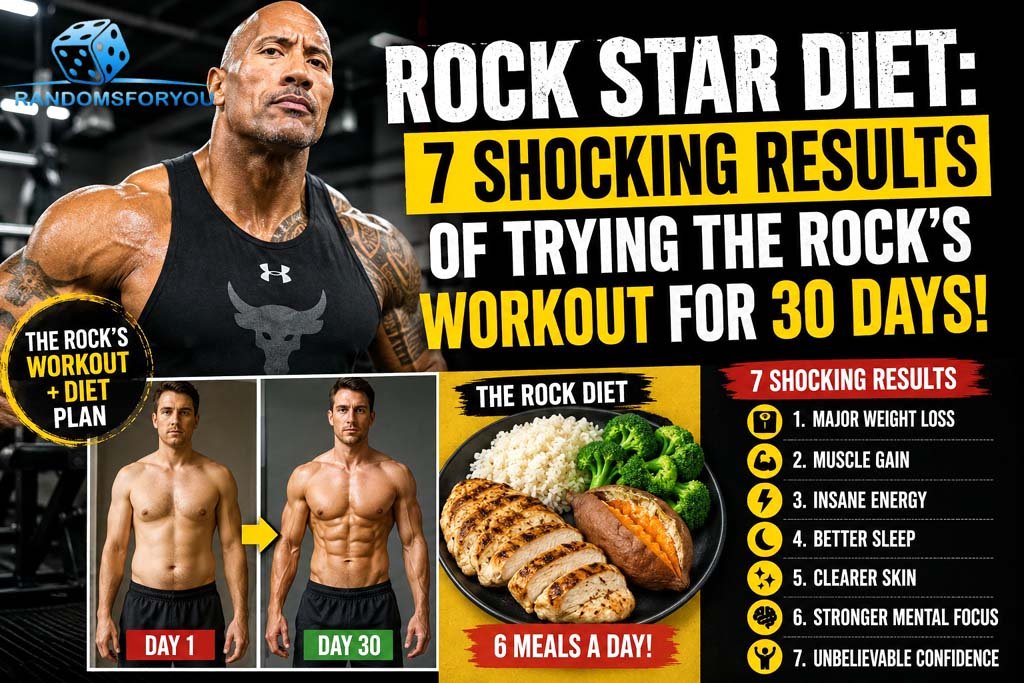
I Ate and Trained Like Dwayne ‘The Rock’ Johnson for a Month—Here’s What Happened
Introduction
Dwayne “The Rock” Johnson is practically synonymous with superhuman fitness. The former wrestler turned Hollywood megastar maintains a physique that seems carved from granite, reportedly consuming up to 8,000 calories a day at his peak and spending hours in the gym six days a week . His legendary diet and training routines have become the stuff of internet folklore.
But what happens when an ordinary person—not a professional athlete, not a movie star—attempts to live like The Rock for an entire month? Curious to learn the answer, Reddit member Mark Webster, better known as “nycballer,” took on the challenge himself. At 37 years old and with no aspirations of becoming a bodybuilder, he embarked on a 33-day experiment to eat and train exactly like Dwayne Johnson .
His journey reveals not just the physical transformation, but the mental toll, the financial cost, and the surprising lessons about discipline, diet, and what the human body can actually handle.

The Challenge: Living Like The Rock

The Diet: 5,390 Calories of Pure Discipline
The first thing Webster discovered was that eating like The Rock is both expensive and time-consuming. The daily meal plan included seven meals totaling approximately 5,390 calories—less than Johnson’s 8,000-calorie peak but still far beyond what most people consume .
Here’s what a typical day looked like :
Meal 1: Enjoy 10 oz of cod with two whole eggs and two cups of oatmeal.
Meal 2: A balanced serving includes 8 ounces of cod, 12 ounces of sweet potato, and one cup of veggies.
Meal 3: 8 oz chicken, 2 cups white rice, 1 cup veggies
Meal 4: 8 oz cod, 2 cups rice, 1 cup veggies, 1 tbsp fish oil
Meal 5: Enjoy 8 oz of steak served with a 12 oz baked potato and a spinach salad.
Meal 6: Enjoy 10 oz of cod served with two cups of rice and a side salad.
Meal 7: 30g casein protein, 10 egg-white omelet, 1 cup veggies, 1 tbsp fish oil

The nutritional totals come to 533 grams of carbohydrates, 97 grams of healthy fats, and 430 grams of protein.
Webster spent an hour and a half every two to three days on meal prep alone. Each meal took approximately 20 minutes to eat, meaning he dedicated nearly two and a half hours daily just to consuming food . The cost? A staggering **$42.07 per day**—over $1,300 for the month. Just the cod alone cost $18 daily .
The Workout: Two Hours, Six Days a Week

The training regimen was equally demanding. Webster followed The Rock’s reported routine :
50 minutes of cardio (elliptical) six days a week
90 minutes of weight training following a specific split:
Monday: Chest
Tuesday: Legs
Wednesday: Arms
Thursday: Back
Friday: Shoulders
Saturday: Legs (repeat)
Sunday: Rest
Each workout involved multiple exercises with high volume—for example, leg day included leg extensions, leg press superset with walking lunges, hack squats, Romanian deadlifts, and calf raises .
In total, Webster had to commit five hours a day to working out, eating, and food preparation .
The Results: What Changed After 33 Days

Physical Transformation

After the month-long experiment, Webster’s weight had barely moved on the scale. However, he had gained solid muscle mass and estimated his overall strength had increased by 10 to 15 percent across all major lifts .
The more subtle but significant changes included :
No more aches and pains—at 37, he reported feeling better than before the experiment
Resting heart rate dropped by approximately four beats per minute
Enhanced recovery—he felt the routine prevented muscle soreness

The Mental Challenge

Webster described the experience as “extremely positive” but acknowledged the difficulty. The sheer volume of eating and training was all-consuming. He used podcasts and audiobooks to keep his mind engaged during the two-hour gym sessions six days a week .
The monotony of eating the same seven meals daily was perhaps the toughest mental hurdle. As The Rock himself has said about his diet: “He taught me very early on not to eat to please the tongue but to eat to nourish the body” . Webster discovered just how challenging that philosophy is to implement in practice.
What The Rock Thought
Dwayne Johnson himself noticed Webster’s experiment. Initially skeptical, he questioned whether anyone could truly follow his routine. However, as Webster documented his progress and completed the challenge, Johnson changed his tune and offered his respect .
The actor’s acknowledgment added a layer of validation to Webster’s grueling journey.

Lessons for Regular People

Webster’s experiment offers valuable insights for anyone inspired by The Rock’s physique:
1. The Cost Is Prohibitive
At over $1,300 per month just for food, The Rock’s diet is financially out of reach for most people . The sheer quantity of fresh cod, steak, and chicken adds up quickly.

2. Volume Doesn’t Always Mean Quality

As one YouTuber who tried The Rock’s routine for a single day noted, the workout volume may be “ten times too much” for most people. He observed that his form deteriorated in later sets and recommended quality over quantity .
3. It’s a Lifestyle, Not a Quick Fix
Webster spent five hours daily on eating and training. For the average person with a full-time job and family commitments, this is simply not sustainable. The Rock himself acknowledges that maintaining his physique is “constant work, constant tweaking” .

4. Even The Rock Takes Breaks
The importance of cheat meals cannot be overstated. The Rock is an advocate for weekly indulgence, saying: “I do believe in working hard throughout the week and earning your cheat meals” . His famous cheat meals—giant pancakes, sushi platters, and bacon cheeseburgers—serve as both psychological rewards and metabolic resets .
Conclusion: Would Anyone Recommend This?
Despite the challenges, Webster’s overall assessment was clear: he “highly encourages” anyone to try the experience for themselves . The improved strength, reduced aches, and lower resting heart rate made the month worthwhile.
However, he also made it clear that the purpose wasn’t to become The Rock. It was about challenging limits, understanding discipline, and proving that ordinary people can push themselves further than they think.
The Rock’s routine is not a blueprint for everyone. It reflects years of specialized training, professional dietary guidance, and a lifestyle built around physical performance. But it does offer inspiration: if a 37-year-old regular guy can survive a month in The Rock’s shoes, perhaps we can all push our boundaries a little further.
According to Johnson, manageable discomfort is a natural part of making progress during workouts.

About the Author
My name is Dua Qamar, and I am a content writer fascinated by stories of human endurance, physical transformation, and the limits of what ordinary people can achieve.
Why I Wrote This Article
I came across Mark Webster’s experiment while researching fitness challenges and was immediately hooked. The idea of an ordinary person attempting to live like one of the most physically demanding celebrities on the planet—not for fame or fortune, but simply to see if it was possible—resonated with me. It speaks to something universal: the desire to test our limits and discover what we’re truly capable of.
How I Approached This Topic
I gathered information from Webster’s own accounts, fitness publications, and interviews with Johnson himself. I wanted to present not just the “what” of the experiment, but the “how”—the practical realities of eating seven meals a day, the financial cost, the mental fatigue, and the actual physical results.
Who This Article Is For
This article is for anyone who has ever looked at The Rock and wondered, “Could I do that?” It’s for fitness enthusiasts curious about extreme routines, and for everyday people looking for motivation to push their own boundaries—even if on a much smaller scale.
The Message I Hope Readers Take Away
Physical transformation is rarely about quick fixes. Achieving your goals requires dedication, discipline, and the commitment to show up day after day. Webster didn’t become The Rock, but he became a better version of himself. That, perhaps, is the real lesson.
Written by: Dua Qamar


1 Comment
Pingback: 10. Can Beer Help You Lose Weight? Surprising Science Beh