


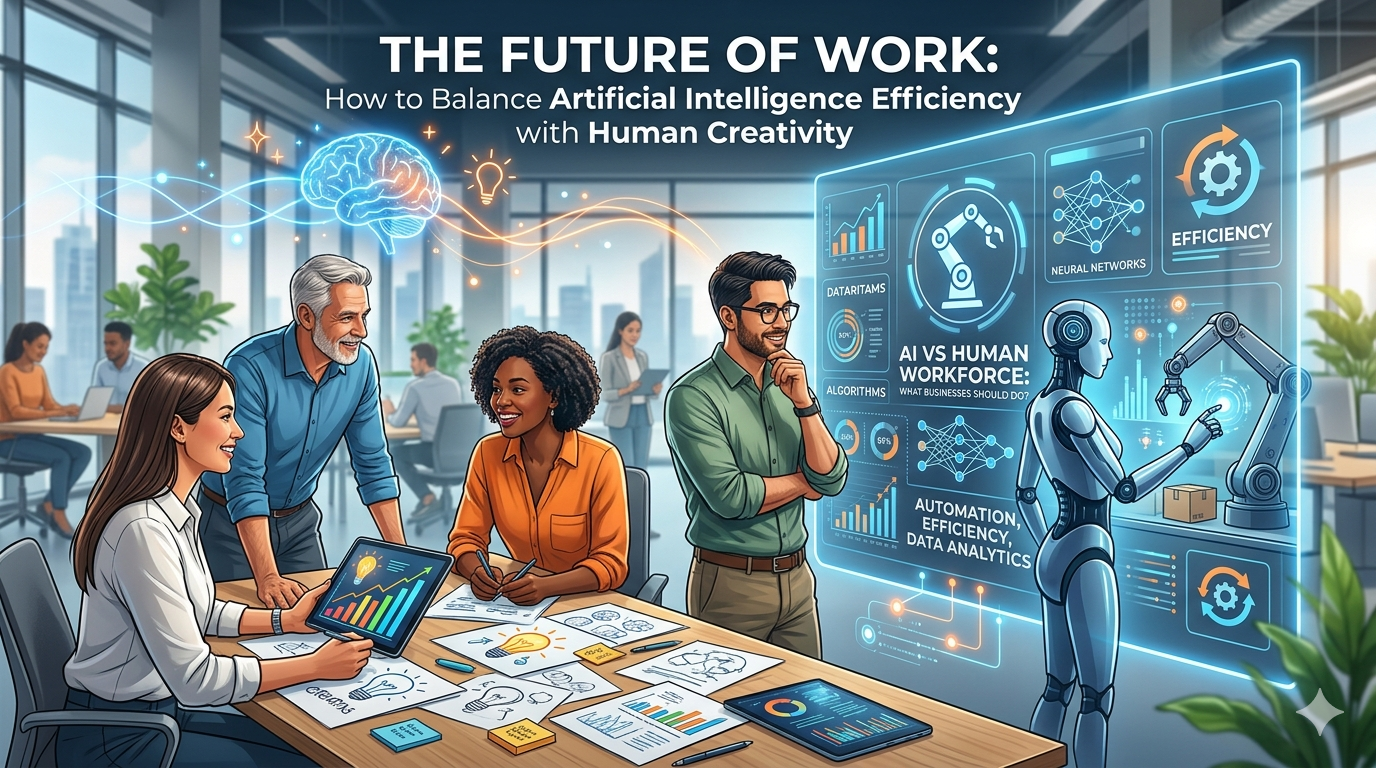
AI vs Human workforce: What businesses should do?
Artificial Intelligence (AI) is changing things quickly in the modern workplace. AI has developed into an effective method for companies in a variety of fields, from automating repetitive activities to enabling sophisticated data analysis. However, human workers contribute critical thinking, creativity, and emotional intelligence qualities that machines still find difficult to imitate. A significant dilemma has been raised by the increasing interaction between AI and the human workforce. The companies should find a way to incorporate both AI and humans, or should they replace humans with AI? Companies must find out how to combine AI capabilities with human qualities in order to succeed in the long run.

AI(Artificial Intelligence) in the Workplace:
AI describes devices or software programs that are capable of carrying out tasks that normally call for human intelligence. These include making decisions, identifying patterns, learning from data, and even speaking in natural language.
AI is frequently utilized in the workplace for:
Automating monotonous processes, such as scheduling and data entry
Customer support (virtual assistants and chatbots)
Forecasting and data analysis
Cybersecurity and fraud detection
Customization in advertising
AI systems are quick, effective, and able to process massive amounts of data without getting tired. They are therefore very useful for raising output and decreasing expenses.
Strengths of AI(Artificial Intelligence) Workforce:
AI(Artificial Intelligence) is far quicker than humans at processing information. AI systems can frequently finish tasks that take hours for humans in a matter of seconds.
AI lowers human error, particularly in data processing and calculation-related jobs.
AI systems are more productive than human workers because they can work nonstop.
AI can eventually reduce labor expenses by automating repetitive tasks.
AI is quite good at examining big datasets and seeing trends that people would overlook.
Limitations of AI(Artificial Intelligence):
AI(Artificial Intelligence) has a number of drawbacks despite its benefits:
AI is unable to actually innovate or think creatively, unlike humans.
AI is unable to fully comprehend human relationships, emotions, or empathy.
Data is essential to AI systems. Inaccurate conclusions might result from biased or inadequate data.
Concerns regarding the adoption of AI are raised by issues including bias, privacy, and job displacement.

Strengths of Human Workforce:
Humans are capable of original thought, innovative problem-solving, and idea generation.
Workers are able to establish rapport, comprehend client needs, and show empathy.
Humans are adaptable, quick learners, and capable of overcoming unforeseen obstacles.
Moral judgments can be made by people using their social awareness and ideals.
Teamwork, leadership, and company culture all depend on people.
Limitations of Human Workforce:
People can make mistakes, particularly when they’re overworked or exhausted.
AI(Artificial Intelligence) is more efficient than humans in handling massive amounts of data.
Salaries, advantages, and training can be costly for companies.
Human performance can differ based on motivation and other influences.
Key differences of AI(Artificial Intelligence)vs Human Workforce:
There are some significant differences between the human workforce and artificial intelligence (AI). When it comes to speed, AI can do jobs in a matter of seconds, but humans typically operate at a steady pace. When it comes to accuracy, AI is quite precise, particularly when it comes to data-driven activities, while human accuracy varies based on experience, concentration, and exhaustion. Another significant distinction is creativity. AI is not very good at coming up with new ideas, but humans are quite inventive and creative.
They also stand out for their emotional intelligence.
AI lacks empathy and emotions, but humans have high emotional intelligence and are able to comprehend emotions, form bonds with others, and communicate clearly. In terms of cost, AI may be more economical over time since it eliminates the need for ongoing labor costs, whereas human workers are more costly due to their need for pay, advantages, and training. Lastly, in terms of adaptability, people are extremely adaptable and can adjust to unique circumstances, obstacles, and surroundings, but AI systems are restricted to the jobs for which they are designed.
Overall, these distinctions show that people and AI are complementary forces that can cooperate to enhance corporate success rather than direct rivals.
What businesses should do?
At first, a lot of companies saw AI(Artificial Intelligence) as a competitor for human labor. However, this strategy may result in issues like employee resistance, a decline in inventiveness, and a bad public image.
The true potential is when humans and AI work together. While people concentrate on the strategic, creative, and emotional sides of work, AI should deal with repetitive and data-intensive jobs.
Adopt a hybrid workforce model:
Businesses could use both AI(Artificial Intelligence) and human labor instead of picking one over the other. For instance:
Utilize AI to analyze data
Use humans to make strategic decisions.
This strategy preserves innovation while boosting efficiency.
Invest in employee training:
Employees need new skills as AI grows increasingly prevalent. Companies ought to:
Instruct AI systems and digital tools.
Promote lifelong learning
Develop abilities like creativity and critical thinking.
Employee upskilling guarantees their continued value in an AI-driven workplace.
Redesign jobs:
Businesses should rethink responsibilities rather than replacing employees:
Automate monotonous activities
Permit workers to concentrate on higher-value tasks
Productivity and job satisfaction both increase as a result.
Focus on Human-Centered skills:
Skills that are difficult for AI to imitate should be given priority:
Communication
Leadership
Emotional intelligence
Creativity
In the future, these abilities will be increasingly valuable.
Ensure ethical AI(Artificial Intelligence) use:
Companies need to deal with ethical issues by:
Be clear of biased algorithms
Security user information and confidentiality
Being open about the use of AI
Responsible AI fosters employee and customer trust.
Encourage collaboration between AI(Artificial Intelligence) and Employees:
Businesses should design systems that use AI to assist workers rather than to replace them. As an example:
AI tools for making decisions
Automation that lessens labor
Better results and more employee satisfaction result from this.
Monitor and evaluate AI performance:
AI systems need to be examined frequently to make sure:
Results’ accuracy
Equity in judgments
Fulfilment of business objectives
Constant observation reduces hazards and boosts productivity.
Prepare for workforce transition:
The adoption of AI could lead to job shifts. Companies should:
Encourage staff members during changes
Provide reskilling initiatives
Create new jobs wherever possible.
This lessens workers’ resistance and fear.
Future of work collaboration:
AI or humans alone will not be able to work in the future. Rather, both will work together to shape it.
Future trends include, for instance:
AI-powered decision-making
Automated smart workplaces
Demand for strategic and creative positions has increased.
AI-powered remote work
Companies will have an advantage in the marketplace if they can adjust to these developments.
Conclusion:
The justification between AI and the human workforce is about striking the correct balance rather than picking one over the other. AI provides speed, efficiency, and data-driven insights while humans add creativity, empathy, and moral judgment. Businesses that neglect AI risk falling behind in productivity and creativity, while those that concentrate only on AI run the risk of losing their human touch.
Organizations must choose a hybrid strategy that incorporates the advantages of both AI and human labor in order to remain successful in this changing environment. This involves the investments in staff training, rethinking employment, guaranteeing the ethical application of AI, and encouraging cooperation between humans and technology. Businesses may develop a workforce that is more inventive, productive, and sustainable by doing this.
The future of employment will ultimately involve AI collaborating with humans rather than AI competing with humans. In the era of intelligent technology, businesses that grasp this will not only experience but also succeed.
